
Barely larger than a loaf of bread and only available through a private appointment, the Dior Cigale bag is what you get when the world’s biggest luxury fashion conglomerate tries to author the legacy of its most prestigious house as it unfolds.
The Cigale is not merely being sold as a bag, but as a moment. Its value does not come just the design, or the leather, or the craftsmanship. Not even from the status, necessarily. What the consumer is really being asked to purchase is an invitation to participate in a narrative. A transition. A ‘new era’.


On paper, the Cigale bag is a cute shoulder bag inspired by Christian Dior’s 1952 “La Cigale” gown. But, in practice, the bag represents LVMH’s latest strategic effort to redefine what a post-Galliano Dior should be. Following 14 years of uneventful tenures from Raf Simons and Maria Grazia Chiuri, this bag is a corporate heirloom designed to establish Jonathan Anderson as the first Dior designer, since John Galliano, capable of making the house culturally mythic again.
That doesn’t mean that the Cigale is a cynical bag, of course. In fact, this kind of corporate worldbuilding is precisely what makes the bag interesting. It’s genuinely beautiful, cleverly constructed, and historically inspired.
But above all, the Cigale bag is an object engineered to re-mythologize a stagnant fashion maison.


Materials: Softness rooted in heritage
Given its sculpted shape, the Cigale is surprisingly soft. Boasting a supple calfskin exterior and delicate lambskin lining, the bag’s entire identity rests on that tension between softness and structure. The body folds inward like draped fabric rather than behaving like a rigid leather object. Dior repeatedly describes the Cigale’s shape as “architectural” – but the real trick is that it feels textile, not structural. That’s precisely how such crisp folds are possible. In other words, the leather itself is being asked to imitate couture construction.


This is hardly accidental, of course.
Dior’s own editorial language, constantly referencing the 1952 La Cigale dress, reflects LVMH’s corporate strategy to position the Cigale bag as a translation for Dior’s couture heritage rather than simply the latest ‘It bag’. The materials are therefore not only a physical asset to the consumer, but a symbolic asset too.
This is where the Cigale differs from other contemporary luxury bags designed primarily for quiet recognizability. The leather here is not merely trying to signal expense – it is trying to signal historical significance. Dior wants you to feel as though you own a soft fragment of its legendary archive. The leather isn’t exotic, but it is enough for a luxury house like Dior to think that it partially justifies the $4,900 price-tag.
And that emotional effect matters enormously for LVMH. A house attempting to inaugurate a major new creative era cannot rely solely on logos and algorithms. It needs objects that feel instantly embedded in institutional memory. If they hope to make Dior culturally mythic again, then LVMH needs a bag that’s rooted in historical legitimacy, not in fickle consumer culture.
It is not sufficient that the Cigale is potentially vintage – it must be immediately vintage.
Craft: Couture technique and personality
Much like the materials, the Cigale’s construction is impressive, but not revolutionary.
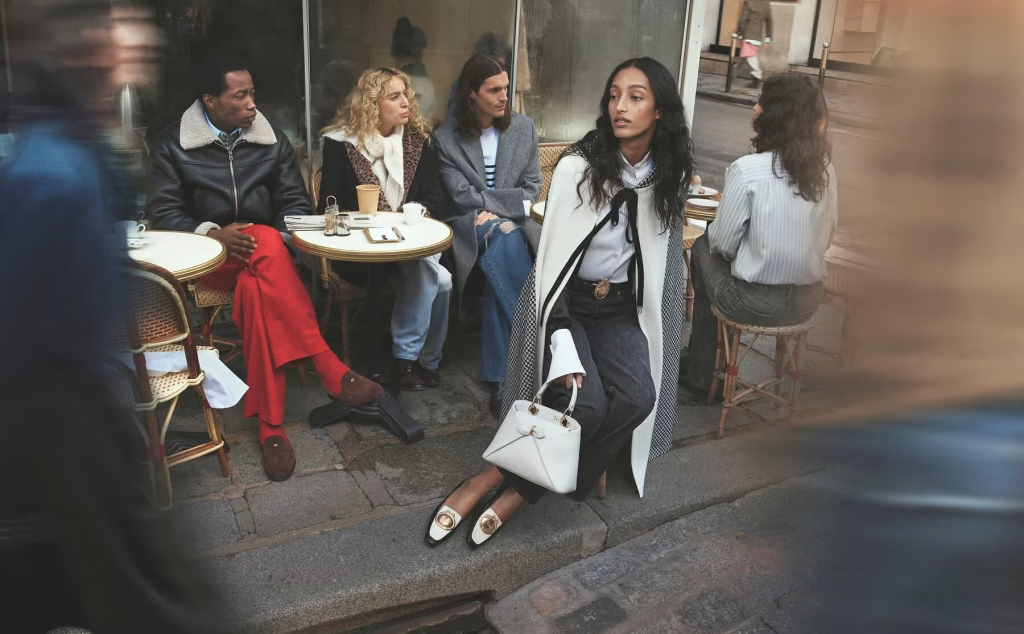
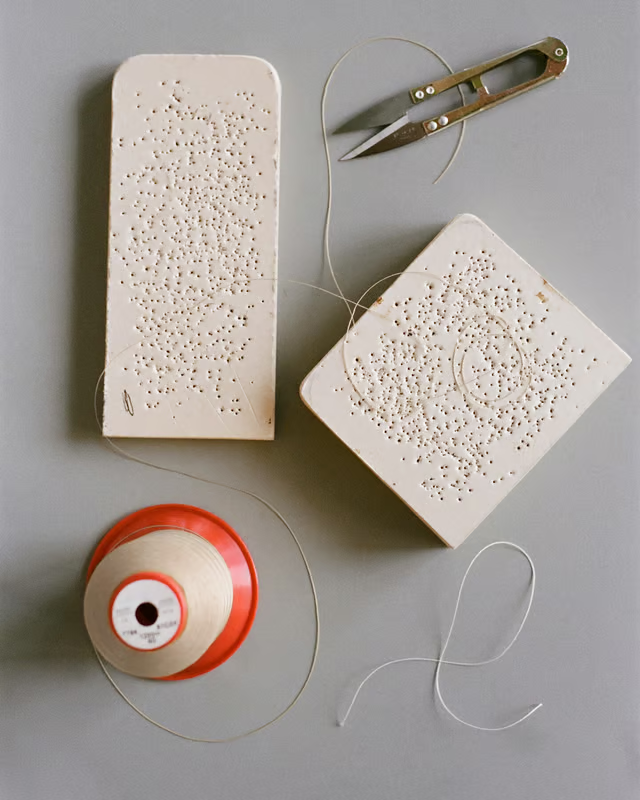
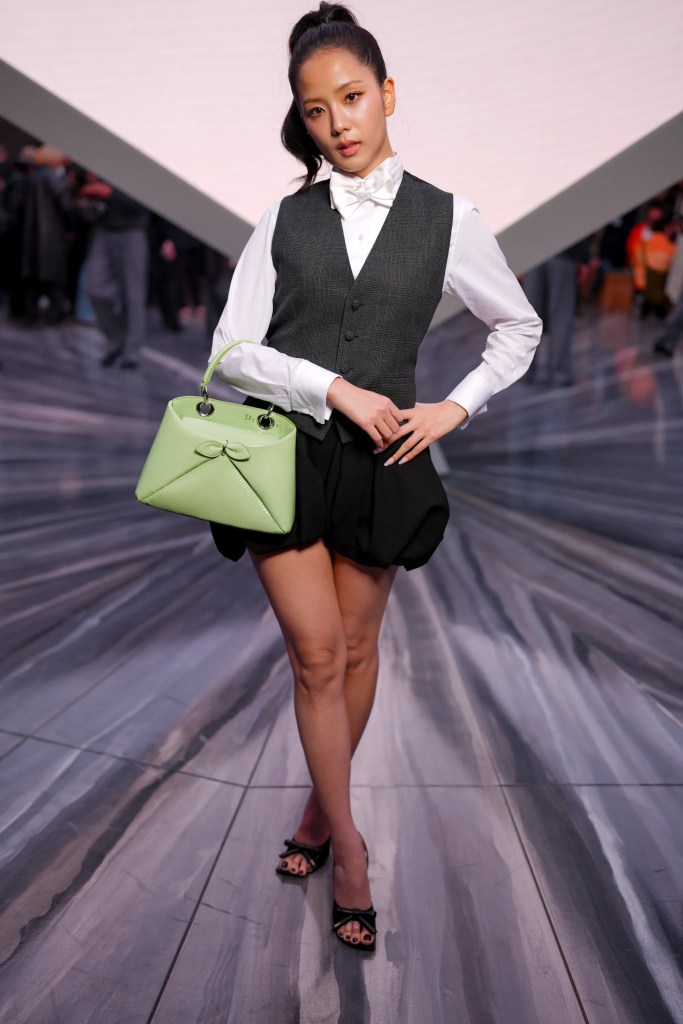
The folded side structure, sculptural bow-like profile, and curved silhouette require far more precision than the average minimalist luxury totes currently dominating the market. The way the bow cinches the sides together gives the Cigale a gift-like quality – a present ready to be unraveled. That shape is one of the product’s main selling points – it’s not simply meant to be the trendiest bag, but as a uniquely artifact crafted from Dior’s couture legacy.
Christian Dior’s own financial reporting shows ‘Fashion & Leather Goods’ as the dominant revenue category within the broader business structure, carrying enormous operating margins for LVMH. Leather goods are where creative mythology becomes industrial-scale profitability.

Which means the Cigale bag has to achieve two things simultaneously: be a believable couture-adjacent product, and be commercially scalable. That balancing act is extremely difficult. The bag must be modest enough to be timeless but ambitious enough to comply with LVMH’s ‘new Dior era’ mythbuilding.
The craftsmanship is therefore doing more than justifying the price – it is cementing Jonathan Anderson’s presence at Dior.
And that’s really the ingredient Dior has been missing. Post-Galliano Dior has remained commercially dominant and culturally respected, but the fashion house has lost its creative audacity – the kind that comes from a daring designer with a unique vision.
Even if many do not see Anderson as being particularly ‘audacious’, the Cigale bag is nonetheless an engineered attempt to solve that problem.

Design: Timeless, but instant
Everything about the Cigale bag is intended to be timeless the instant it hits the market. The archival references, the delicate folds, the modest pastels – it’s an attempt to manufacture Anderson’s legacy in real-time. Timelessness delivered ahead of time.
This is hardly surprising.
Luxury fashion moves too quickly now. Designers rotate, collections disappear, trends become obsolete – all within months. Modern luxury houses no longer wait for cultural memory to emerge organically. Time is no longer the maker of legacies, but instead it’s now digital engagement and algorithm dominance. If Tom Ford has shown us anything, it’s that modern luxury consumers are placing an increased emphasis on the perceived status and recognizability of a brand rather than the depth of its history. The Cigale reads as a clear example of this strategy.
Dior doesn’t just want to sell the consumer a pretty design. It wants to sell the consumer the ‘privilege’ of being included in the house’s ongoing mythology – to be present for the new era of Anderson’s Dior.
This is not unlike what Jonathan Anderson did during his golden years at Loewe. His strongest designs felt less like products and more like historical artifacts, rich with intellectual references.


The Cigale imports that methodology into Dior – in fact, this would explain why LVMH saw Anderson as a fitting choice for the role.
The result is a bag that behaves like institutional propaganda. And to be clear: I do not mean “propaganda” as a dirty word. Luxury fashion has always rested on mythology and perception. The difference is that now that myth-building process is at lightspeed. The industry no longer has to wait, quietly hoping that their latest $4,900 bag will become ‘iconic’ years later. By using the recognizable design language of Christian Dior that signals status and elevation, the Cigale bag is designed to seem like it’s existed for a century. It launches the object, already wrapped in the language of prestige.
And honestly? It’s working.
Branding: Curated scarcity
The Cigale arrives at a particularly consequential moment for both LVMH and Dior.
After more than a decade of commercially successful but comparatively restrained creative eras under Raf Simons and Maria Grazia Chiuri, the luxury juggernaut appears to restore Dior’s cultural power. LVMH’s own communications describe Jonathan Anderson’s arrival as a “defining new chapter” – language that frames his appointment as a strategic turning point rather than the usual routine leadership change fashion houses are so used to now.
And at the center of that strategy is the Cigale bag. The bag is intended as the symbol of Dior’s rebirth, giving the bag enormous branding power.


Luxury houses understand that consumers are not content with beautiful objects alone – they want to own something that appears to elevate them. The Cigale appears to be LVMH’s attempt at trying to satisfy that deeper, almost visceral, desire. It’s no surprise that, in the US, the Cigale is only available via private appointment. In fact, sources even suggest that some quantities are only available to VICs (“Very Important Clients”) through private invitation – not unlike what Hermes has built with the Birkin bag.
These aren’t just retail quirks, but deliberate branding decisions. The bag officially hit stores around March 19, 2026, in extremely limited quantities. The bag’s controlled scarcity, combined with its archival referencing and association with Anderson’s succession narrative, means that the Cigale is being branded not as something only a few can own, but as something only a few are allowed to own. It is not sold, it is allocated. The Cigale’s branding helps position Dior as not just a tastemaker, but as a taste-bestower.


Conclusion
In purely physical terms, there is very little to criticize about the Cigale bag. Its leather is subtle, its construction is disciplined, and its design is delicate and alluring. But, at $4900, Dior is clearly not just charging for some calfskin, stitching, and labor. It’s charging for the chance to participate in a narrative woven from Dior’s past for Dior’s future.
The Cigale is Jonathan Anderson’s first major contribution to Dior’s handbag canon, and it has been engineered to feel less like a new product and more like a rediscovered artifact. Its references to Christian Dior’s creative past, its immediate archival aura, and its tightly managed release all serve one purpose: to signal Anderson’s arrival as historically significant. In that sense, the bag functions as a corporate heirloom, created to lend instant legitimacy to a new creative regime.
And that’s perhaps the most remarkable part of the Cigale.
This bag demonstrates how modern luxury no longer waits for history to cultivate prestige. It manufactures that prestige in advance. It’s a bag that is softened by heritage, protected by scarcity, and positioned as a badge – something customers are not sold, but permitted to buy.
Whether that justifies the $4,900 price-tag or not depends on how much the customer values participating in this corporate dance. If the goal is simply to own a well-made leather bag, then there are countless cheaper alternatives. But if the goal is to own a small, carefully rationed piece of Dior’s next chapter, then the Cigale offers something far more potent than utility.
You are not buying a handbag. You are buying the feeling of having been chosen.


