
There’s a shift happening in luxury fashion. There was a time when luxury pricing required explanation.
The impossible price tag was visible in the object itself — the stitching, the materials, the technique – the labor embedded into a piece designed to last decades. Storied fashion houses like Hermès did not simply sell products; they sold a clear relationship between cost and construction. The price of a Birkin bag could be understood, even if it was out of reach.
But not everyone in fashion plays by those rules. Luxury newcomer Tom Ford (and consistently at top lists every fashion week) enters the market within the same pricing airspace as a two-century old house like Hermes, with barely 20 years under its belt.
Not below. Not adjacent. Parallel.


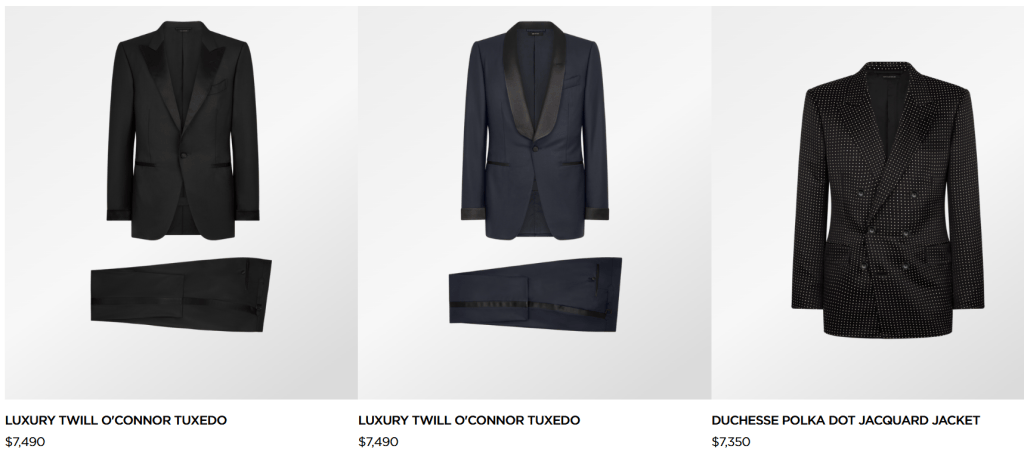
The brand, founded in 2005, sits comfortably in the upper tier of the market. A tuxedo can exceed $5,000. Leather outerwear often falls between $6,000 and $8,000. Even fragrance – typically a lower barrier category – regularly reaches $250 or more. While Hermès occupies a different product mix, the broader positioning overlaps: both operate within a space where price signals exclusivity rather than accessibility.
The difference is that Hermès arrives at that position through accumulated history and renowned craftsmanship. Tom Ford arrives there directly, like a commoner crashing a royal wedding and sitting right up the front.
On paper, this shouldn’t work. A baby brand, without inherited craft traditions, is able to price itself alongside a historically entrenched luxury house that is defined by them – and does so without significant resistance from the market.
How is this possible?
Constructed Legitimacy
Tom Ford did not build its identity gradually. It began with a fully formed point of view.
That is largely due to Tom Ford himself. The American designer’s tenure at Gucci in the 1990s established him as one of the most influential designers of his generation. He had revived the dormant Italian house and with it rewrote the tone of luxury itself. The Gucci woman of the late 1990s and early 2000s was dangerous, provocative, and risky. Tacky even, some would say. Who could forget the brazen S/S 2003 campaign with the Gucci logo groomed into a model’s pubic hair? It was that kind of unapologetic audacity that positioned Tom Ford as a designer who was uninterested in conforming to the tastes or standards of the establishment. He would not wait for an invitation or approval from the old guard.


By the time he launched his own label, Tom Ford was not an emerging figure – he was already associated with a specific vision of modern luxury (not unlike John Galliano’s journey).
That credibility transferred directly into the brand.
Unlike traditional European houses, which draw legitimacy from lineage, Tom Ford relies on authorship. The brand is structured around a singular identity: hyper-sexual, relentlessly polished, and flagrantly visible. This is what makes it distinctly American. Tom Ford represents that new hot rich ruthless success that is easy to recognize and demands dominance.
Ford’s success extends beyond fashion helped further cement his myth. His work in award-winning films like “A Single Man” and “Nocturnal Animals” has reinforced the same aesthetic sensibility. The visual language remains consistent: restraint, precision, and a highly managed surface. Across mediums, the effect is cumulative.
Rather than building a narrative over time, the brand presents one that already appears complete.


Structural Support
Don’t let Ford’s celebrity fool you though. For a brand built on perception, consistency between image and product is essential. And Tom Ford maintains that consistency through the company’s infrastructure.
Since 2023, its fashion business has operated under the Ermenegildo Zegna Group. Zegna provides a well-established manufacturing base, particularly in menswear, where fabric development and tailoring are critical. This ensures that the product meets the expectations set by the brand’s positioning.


Zegna isn’t just a brand, it’s a mill owner. The company boasts historic Italian mills like Lanificio Zegna, producing some of the world’s most exquisite wools and cashmeres. It’s important to note that Zegna maintains an almost dictatorial control over its manufacturing. It’s production is heavily concentrated in northern Italy, compared to most other luxury brands who split production across Italy, Eastern Europe, and beyond.
This doesn’t necessarily mean that Tom Ford’s garments outcompete Hermès’ in terms of artisanal narrative. But they do reach a level that removes quality as the deciding factor in justifying top-tier pricing.
Pricing reinforces this structure. Tom Ford entered the market at a high price point and has remained there. In this context, price functions less as a conclusion and more as a signal – it defines how the product is to be interpreted before it is evaluated. The garments don’t justify the price – it’s the price that justifies access to the garments.

Other categories extend that signal. Fragrance, beauty, and eyewear introduce the brand to a wider audience while maintaining a relatively high price threshold. These products do not dilute the image; they reinforce it by repeating the same positioning across different entry points.
Distribution is similarly controlled. The brand’s presence is selective and consistent, which maintains a sense of distance from the mass market. Availability is managed in a way that supports the perception of exclusivity, regardless of actual production scale. In fact, while other luxury brands like Dolce & Gabbana are handing out “global ambassador” labels to hosts of celebrities, Tom Ford has never relied on such common marketing tactics. It signals that the brand doesn’t need to borrow celebrity visibility – but it’s the celebrity who borrows Tom Ford’s authority.


A Shift in What Luxury Means
Tom Ford’s pricing does not exist in isolation. It reflects a broader shift in how luxury is understood.
Historically, value was tied to intuitive tangible qualities: materials, labor, and the time required to produce an object. These factors provided a basis for comparison between brands.
That basis has become less central the how consumers make decision around buying luxury fashion products.
The question is no longer strictly whether one product is materially better made than another, but how much aspirational capacity the consumer perceives in the product. Consumers are increasingly deprioritizing the importance of material quality in favor of perceived status, recognizability, and social signaling.


In that context, Tom Ford does not need to replicate Hermès’ approach to craftsmanship. It operates within a different framework – one where clarity of image and consistency carry more weight than demonstrable technical superiority.
The comparison shifts accordingly. Instead of asking whether the products are equivalent in construction, the consumer assesses whether they belong to the same category.
Once that alignment is established, the price becomes easier to accept.

Tom Ford does not charge Hermès prices because it mirrors Hermès in history or production methods.
It does so because it operates effectively within a system where those factors are no longer the sole determinants of value.
Its legitimacy is constructed through a clearly defined identity, credible production support, consistent pricing and distribution, and repeated exposure across a variety of categories.
Within that system, the relationship between price and product becomes less direct.
The value is not only in what is made, but in how it is positioned in front of the consumer – and how consistently that position is maintained.


