
Every year, long before Jeff Bezos and Lauren Sanchez buttered their way in, the Met Gala returns with the same familiar spectacle: celebrities ascending museum steps in custom haute couture, press cameras flashing, commentary unfolding in real time across every platform.
It is presented as culture. As fashion. As art.
That’s the story at least.
The most expensive garments in the world are reframed as creativity. Extreme exclusivity becomes something to admire. A guest list of a few hundred turns into an audience of millions – watching, ranking, applauding, rinsing and repeating.
What this actually does – every year – is turn extreme wealth into something you’re supposed to admire.
A single ticket costs roughly $75,000. Tables exceed $350,000. The event itself raises around $26 to $31 million annually for the museum, funding exhibitions and related services.
But the surrounding media ecosystem generates something far larger: an estimated $995 million in media value was generated 2023, rising to over $1.4 billion in 2024.


Individual brands routinely extract tens, even hundreds, of millions of dollars in exposure. Chanel alone has generated over $110 million in media impact from a single Met Gala, with other top-performing brands like Louis Vuitton reaching similar high nine-figure exposure levels in subsequent years.
That money doesn’t ‘trickle down’. It is circulated back to the same brands, the same institutions, the same sources of wealth that made the spectacle possible in the first place.
And yet, millions of ordinary people watch the gala like it belongs to them.
That contradiction is not accidental. It is an intentional structure designed to extract more wealth from the economy, and relies on the public’s participation to achieve it.
The Met Gala is not just a reflection of wealth inequality. It is a ritual that conditions the public to admire it, emotionally participate in it, and ultimately normalize it.
The Illusion of Access
The modern Met Gala is no longer an exclusive event in the traditional sense. It is an exclusive event made hyper-visible.
Livestreams, red carpet interviews, TikTok breakdowns, “best dressed” lists – every angle of the night is delivered to the public in real time across platforms. In 2024, Met Gala content generated over a billion dollars in media impact value (MIV), a metric used by firms like Launchmetrics to estimate how much visibility translates into equivalent advertising dollars.


Viewers are encouraged to critique, rank, and debate the looks as if they are part of the process.
And in a superficial sense, they are.
You can comment. You can repost. You can participate.
But participation is not access. You’re still not ‘one of them’.
The event remains structurally closed: invitations are not open – they are curated: approved (or vetoed) by Anna Wintour herself, allocated through luxury brands, and filtered through a small network of institutional gatekeepers. And even for those invited, entry is often contingent on brand sponsorship, public relevance, or strategic value. Entry is selective by design – controlled by the same institutions, brands, and individuals whose power the event exists to reinforce.
The barrier is not just social but also financial. $75,000 for a single ticket or $350,000 for a single table means that the attendance is not only limited by social value, but by economic design.


What changes is not the exclusivity of the event, but the visibility of it.
This creates a powerful illusion: that proximity equals inclusion.
It doesn’t.
You are close enough to watch – but never close enough to belong.
What you are being offered is not real access to power – but the illusion that you are closer to it than you really are.
The Economics of the Spectacle
To understand the Met Gala’s deeper impact, beyond the cultural moment, you have to understand it as an economic system.
The Met Gala is described as a ‘charity event’ – and technically it is. The event raises tens of millions for the Costume Institute. On paper, it’s philanthropy at scale. But in reality, it’s something closer to a closed financial loop. A financial engine powered by the global marketing infrastructure built around it.
Luxury brands do not spend hundreds of thousands – or more realistically, millions – on a single appearance out of artistic generosity. A single look involves complex couture production, celebrity contracts, stylists and glam teams, and PR coordination. Total costs for a major placement can easily reach into the high six or seven figures. For example, an Haute Couture gown from Christian Dior or Chanel easily costs anywhere from $100,000 to an eye-watering $800,000. Publicists alone can cost several thousand per event, while top stylists and glam teams – particularly at the highest level, can command significant higher fees, often reaching into the tens of thousands, according to industry reporting.


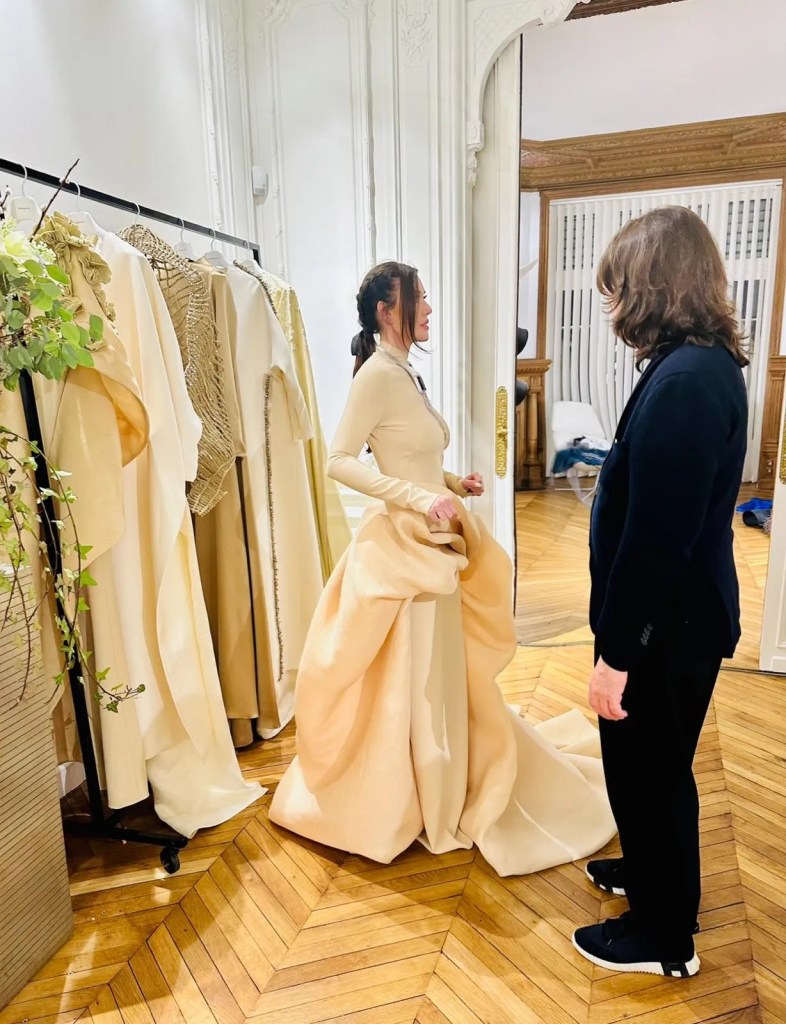
In return, brands receive something far more valuable: earned media exposure at global scale.
In some cases, a single celebrity can outperform an entire seasonal campaign. The math is simple, and revealing. According to Launchmetrics’ Media Impact Value (MIV) metric, Lisa and Zendaya, generated $21.3 and $14.3 million for Louis Vuitton in 2024 in one single night, respectively. At the same event, Bad Bunny generated $9 million for Maison Margiela.
The Met Gala compresses what would normally be a year’s worth of brand storytelling into a single night, then outsources its distribution to the public, for free.
A brand dresses a celebrity, that celebrity becomes a moving advertisement, the public circulates the image – freely, enthusiastically, endlessly.


This is how a dress worn once on a staircase helps justify a handbag priced at $9,100 the following season. The result is a system that raises millions for a museum, while quietly raising billions in brand equity for luxury conglomerates.
Meanwhile, a typical high-profile fashion campaign pales in comparison. For example, Beyonce’s Levi’s campaign generated $5 million in 48 hours, while Zendaya’s for “On” apparel generated $1.7 million in MIV after 2 days.
What appears as a cultural event is, structurally, one of the most efficient – and least visible – marketing mechanisms in luxury fashion.
No traditional ad buy could replicate that level of engagement – because no traditional campaign can convince the public to participate in its own marketing.
The Mechanism: How It Reinforces Wealth at the Top
The Met Gala does not create wealth inequality. But it facilitates it through a repeating loop. And the process is surprisingly efficient.
First, capital is converted into visibility.
Fashion houses with the most resources dominate the event – through design, placement, and sheer presence. They dress celebrities and invest heavily in producing a single moment of visibility. When you see Teyana Taylor or Gigi Hadid wearing Atelier Versace, it’s not cultural generosity – it’s strategic visibility.
These celebrities, who command the followership of millions of fans, convert that visibility into desirability. They don’t just wear the clothes, they translate that unattainable luxury into readily viral content. Every red carpet look becomes an Instagram post, a TikTok breakdown, a YouTube commentary. Then churned through “Best Dressed” rankings and behind-the-scenes influencer coverage – each participant hoping their proximity will make them a beneficiary of that system.
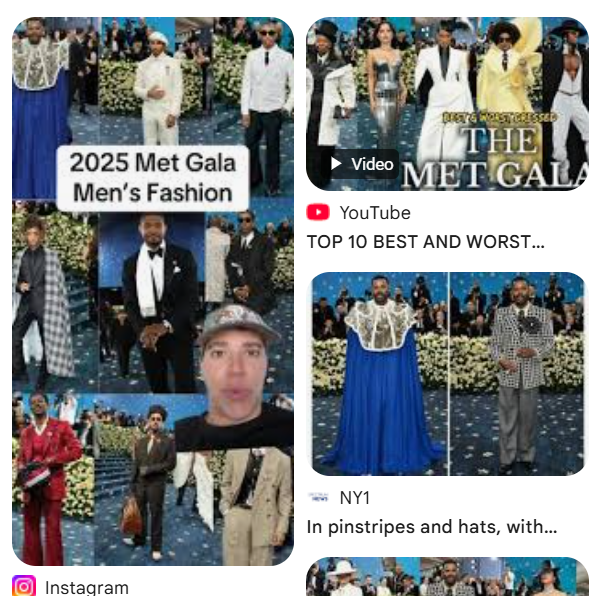

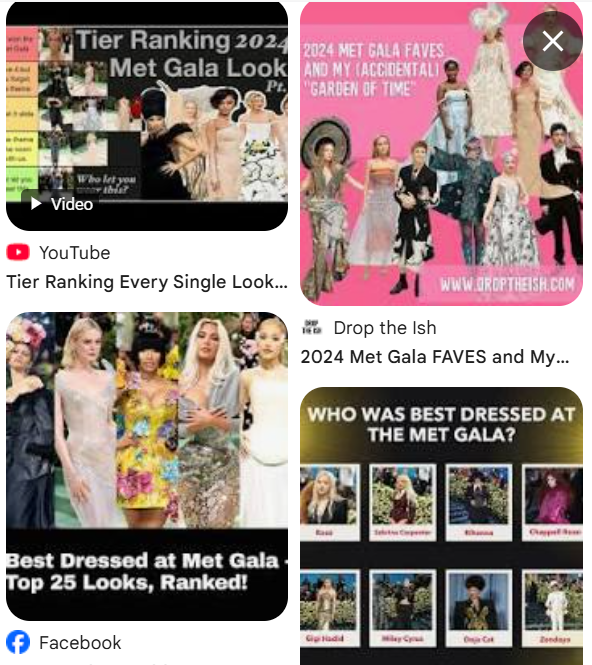
The public don’t just observe – they engage, they rank, they debate, and they share.
The brands that appear most prominently become the most aspirational and the most culturally dominant – and that dominance translates cleanly into retail revenue. Revenue that flows back to the same companies, shareholders, and executive networks.
This logic is hardly hidden in industry language. Richemont (Chloe, Alaia, Montblanc) has consistently described “strategic investment to boost desirability and visibility” of its maisons. Similarly, Kering (Gucci, YSL, McQueen) frames its strategy as “desirability first”.
Then the cycle repeats at the next year’s gala.


At no point does this cycle redistribute wealth. With every next Met Gala, the financial return continues to concentrate among the same brands, executives, celebrities, and institutions that initiated it.
Most importantly, the entire process is culturally legitimized.
Extreme spending becomes ‘artistry’.
Exclusivity becomes ‘aspiration’.
By the time the public is ranking, debating, and sharing it, the underlying inequality no longer feels like a problem. It feels like culture.
Why Fashion Gets Away With It
The fashion industry is hardly unique. Other sectors stage the same concentrations of wealth and the same mechanisms of power.
Big Oil and Big Tech convene in elite forums, like CERAWeek or the Allen & Co Sun Valley Conference. But unlike the glamorous display of the Met Gala, these are often met with immediate criticism – deemed as excessive, ‘tone-deaf’, even “nefarious“.


Fashion gets a pass, however.
The Met Gala is no less a concentration of wealth, access, and influence. And yet, it does not provoke the same sustained outrage. Because when something is beautiful and desirable, society will happily legitimize it.
A $2 million corporate summit is wasteful. A $2 million couture look is ‘visionary’.
A closed-door executive forum is conspiratorial. A red carpet with beautiful actors and designers is ‘artistic’.
This is the industry’s most effective shield against consequence.

It does not avoid criticism – it dilutes it. Not by silencing it, but by styling it. Any discomfort is absorbed into the spectacle itself, softened by beauty, narrative and performance. Even dissent becomes part of the spectacle. When Alexandria Ocasio-Cortez arrived a the 2021 Met Gala in a gown emblazoned with the phrase “Tax the Rich”, the message was framed as protest. But the setting did not challenge it – it amplified it. The image spread globally, drove engagement, and became one of the night’s defining moments. It did not disrupt the system – it was aestheticized, distributed, and ultimately folded back into the very machine it sought to critique.
Where other exploitative industries conceal their power and are condemned for it, fashion displays its power and is rewarded for it with attention.
The Met Gala succeeds not because it hides inequality, but because it makes inequality captivating – and therefore easier to accept.
The Role of the Audience
This is the part that is easiest to ignore.
You do not need to attend the Met Gala to participate in it.
Every view, every repost, every ranking video, every comment contributes to the visibility that makes the event valuable.
That attention is the purpose of the gala: it injects new brand exposure, new cultural relevance, and new desirability into the public sphere.
In other words, it sustains the system.
The Met Gala does not rely on the public’s money. It relies on their attention – which they supply consistently and abundantly.
The system doesn’t just exist above us. It depends on us.

Conclusion
The Met Gala is framed as a celebration of fashion, creativity, and philanthropy.
And it is all of those things. But it is also something else.
It is a ritual—repeated annually, broadcast globally, and consumed collectively.
A ritual that converts wealth into visibility, visibility into desire, and desire back into profit. A system that maintains exclusivity while expanding engagement. An event that transforms inequality into spectacle—and spectacle into culture.
It does not simply display wealth inequality. It disguises it. Reinforces it. Rehearses it.
Until eventually, it no longer feels like inequality at all.
Just fashion.
That’s how it remains acceptable. Not because we can’t stop it – but because we wont.


