
Oh boy. Where do I begin with this one?
Let me just say, I know a distraction when I see one. Especially when it comes dressed in shoddy corporate ‘strategy’. And for a luxury fashion brand like Gucci, currently mired in declining sales, creative uncertainty, and a bizarre price-fixing scandal, you don’t have to squint too hard to see the desperation.
Call me a cynic all you want, but there’s something hilarious about a luxury brand thinking it can salvage its desirability and blur its financial and legal woes simply by plastering its name on a sports empire with its own long history of the same legal and moral rot.
To be clear, Formula 1 is not a stupid move for Gucci. F1 will give Gucci everything it lost when Tom Ford left the building: speed, danger, masculinity, money, and global attention.
And that’s effectively what Gucci’s Formula 1 deal is: not the elevated luxury they want us to believe it is, but a last-ditch corporate strategy poorly veiled as ‘prestige’.
Will Gucci consumers see through it? Will they even care?

Price-Fixing Is Still Fashionable
Apparently, the ancient business practice of price-fixing is still an industry staple in luxury fashion. And it’s enjoyed by far more than just Gucci’s parent company, Kering. In October 2025 the European Commission announced fines of more than €157 million against Gucci, Chloé (Richemont), and Loewe (LVMH) for resale price maintenance. Gucci’s portion was by far the largest: €119.674 million (after a 50% reduction for cooperation). Chloé was fined €19.69 million. Loewe was fined €18.009 million.
The Commission said the houses interfered with the independent pricing decisions of their retailers across the European Economic Area. These were not just vague “brand guidelines” either. Brussels said the brands restricted retailers from deviating from recommended retail prices, limited maximum discounts, controlled sale periods, and in some cases temporarily prohibited discounts altogether.
In other words, luxury fashion crossed into antitrust territory.

And for a good minute too. Gucci’s infringement ran for 8 years, from April 2015 to April 2023. The practices covered almost the full range of products designed and sold by the houses: Ready-to-Wear, leather goods, shoes, and fashion accessories. The Commission also said the brands monitored retailers and followed up when pricing strayed from the preferred line. And retailers generally complied either from the beginning or after pressure.
That detail matters because it punctures one of luxury’s most cherished myths: that prices simply float upward because the product alone is extraordinary, the craft is sacred, and the customer is willing. Of course, desirability matters. Craft matters. Brand power matters. But the Commission’s decision says something less romantic was also happening: retailers were never fully independent and the customer was never fully willing.
This is the ugly underside of “brand elevation”. Luxury speaks constantly in the language of heritage, scarcity, desirability, and image discipline. But when those fail to organically keep up a brand’s allure, the industry has to manually repair the illusion by artificially inflating prices.
Gucci Disclosed Another “Unknown Offense” To Get A Reduced Fine
In typical corporate fashion, Gucci bargained for a 50% reduction in their fine (which was originally closer to €240 million) by cooperating with the Commission and admitting to another infringement of EU competition rules that was not yet known to the Commission.
The rumor is that Gucci had instructed independent retailers to completely pull its best-selling Diana bags from their online stores, reserving online availability solely for Gucci.com



These business misconducts remain invisible until legal enforcement forces it to expose itself.
The public sees the campaign. The store. The runway. The velvet rope. The celebrity placement. The “brand universe”. Regulators see contracts, pressure, compliance, discount policies, and the quiet choreography of who is allowed to sell what, when, and for how much.
That is what makes the Gucci case so useful as a lens. The scandal is not that Gucci behaved ‘badly’. The scandal is that Gucci was forced to reveal something we’ve always known: luxury has never been purely organic market behavior – it’s constructed and controlled. This is something I touched on in my Tom Ford piece. Luxury relies on Veblen logic: the price does not merely reflect desirability, it helps manufacture it.
Enter Formula 1
Get ready to facepalm.
Between financial scandal and stagnant sales, Gucci’s attempt at damage control has come in the form of a Formula 1 partnership. In May 2026, Gucci and Alpine announced that Gucci would become the title partner of Alpine Formula One Team, starting in 2027. The announcement presented the deal as the first time a luxury fashion house has served as title partner of a Formula 1 team.
The language was mostly corporate-speak. Alpine described the partnership as a new business and experiential platform built around performance, precision, discipline, and excellence at the intersection of luxury and sport. The team will compete in Gucci colors, with a dedicated Gucci Racing identity using the interlocking G.
This is not just a sponsorship. It’s narrative laundering.
Gucci does not merely want its name on a car. It wants Formula 1’s momentum, its speed, its global audience, its algorithmic glamor, its paddock mythology, its celebrity traffic, its Netflix-era accessibility, and its ability to make corporate money look like adrenaline. Luca de Meo, now CEO of Kering, framed Formula 1 as one of the world’s most powerful premium content platforms, with a claimed reach of more than 1.5 billion people each season.
He basically said the quiet part in business-school language: this is not only about sport. It is about reach, content, audience, and brand heat.
Less than a year after Brussels fined the house €120 million, Gucci is selling us monogrammed fast cars.
The Irony Is Hilarious
The irony, of course, is that Formula 1 is the least qualified to save anyone’s financial or moral reputation.
For years, human-rights organizations, like Human Rights Watch, Amnesty International and other political coalitions have called Formula 1 out for aiding governments in sportswashing their human-rights abuses.
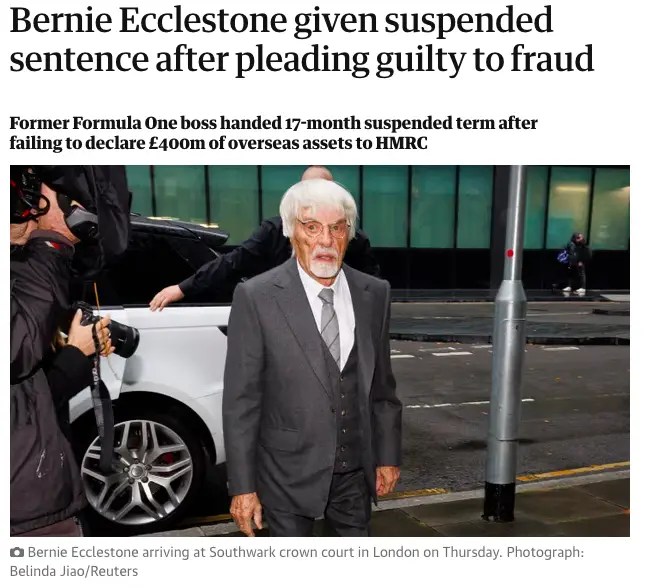
And that’s not even including the sport’s own internal institutional rot. Formula 1 personnel have engaged in both tax fraud and race-fixing.
That does not make the Gucci deal illegitimate. It makes it revealing.
Because the partnership is being sold through words like “discipline”, “excellence”, “performance”, and “precision”, while one of the named figures in the announcement is associated with one of the sport’s most infamous episodes of manufactured outcome.
I WANT to be shocked. My instinct is to question “THIS is who Gucci thinks is going to help rescue its reputation?”. And yet, given Gucci’s history, it makes perfect sense that Formula 1 is the door they knocked on. Who else would know more about turning rot into spectacle?
Will Gucci Consumers Care?
Probably not.
Gucci will almost certainly get away with it and benefit from this partnership. Not because the Gucci buyer won’t find out, but because finding out isn’t the same as caring. The uncomfortable truth is that luxury consumers are not passive victims of the illusion that fashion brands offer them – they are willing participants in that illusion. It’s precisely what they’re paying for.
Luxury consumers want access to exclusivity. They want the perception of an elevated status.
They want the fantasy of socioeconomic elitism.
And when the machinery behind the illusion becomes visible — the price maintenance, the discount control, the strategic partnerships, the sportswashing adjacency, the corporate desperation dressed as prestige — the consumer has every incentive to look away. Not because they are stupid, but because looking too closely spoils the illusion.
Gucci understands this. Luxury understands this. Formula 1 understands this. The fantasy only works when everyone agrees not to stare too hard at the rot holding it up.
Will those who boycott corporate sportswashing stop buying Gucci? Will those who openly preach about the atrocities of Big Oil and Big Tech start doing the same to Big Luxury? Will those who cheer for union strikes and labor movements start calling for the dismantling of the luxury sector?
Most won’t.
Consumers do not want the rich to disappear. Not really. They want the rich to remain glamorous enough to imitate, but distant enough to resent and available enough to sell them pretty things.


