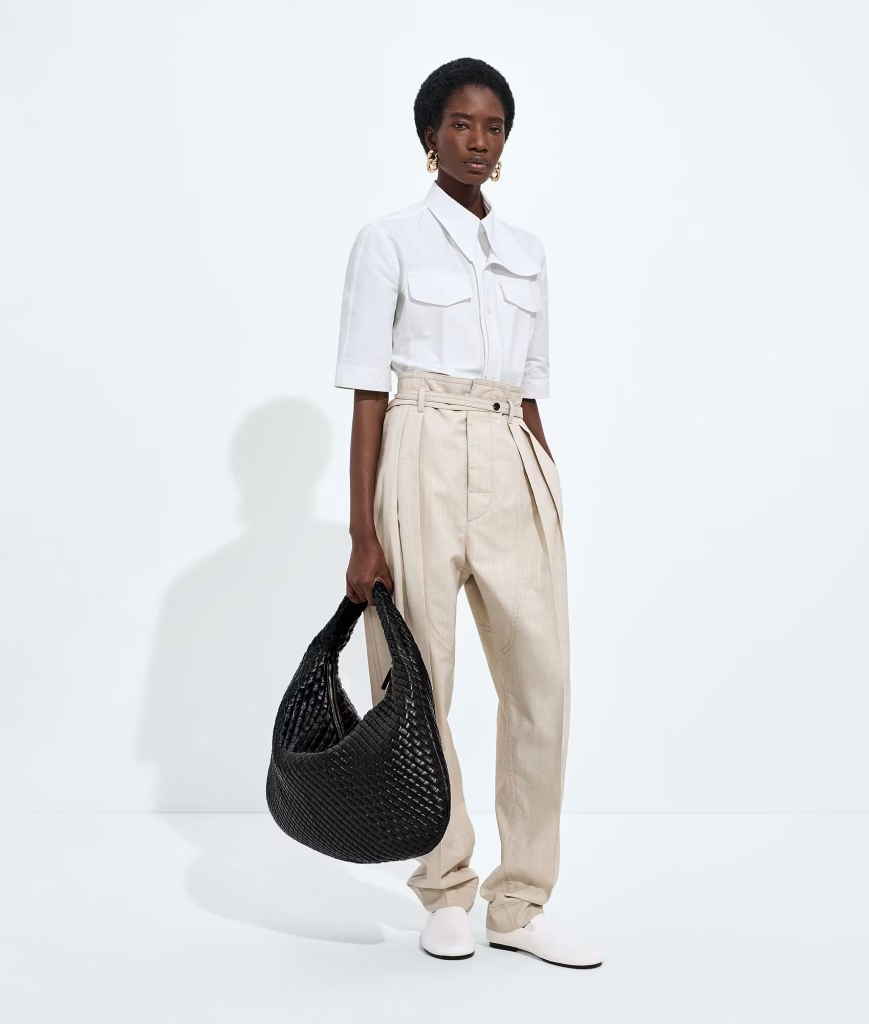
Charging $9,100 for a bag with no logo, in 2026, is brave.
No plaque. No monogram. No chain that screams how rich you are. Just…leather. Soft, woven, deliberately understated leather. The kind of bag that doesn’t ask to be recognized – it assumes you already know.
Bottega Veneta has spent a lot of money over the last decade trying to convince us that it’s the champion of obscure quality. Sky-priced luxury leathers with just enough visibility, while still retaining an air of elite mystery. This makes their Maxi Veneta bag the perfect object to dissect. Because if a brand is going to effectively charge five figures for something this quiet, the justification clearly isn’t relying on visibility. So is the price being justified from elsewhere? Or is this bag (and the brand) all hype and no heft?
Let’s take it apart properly. I’m not necessarily interested in whether it’s “worth it” or not (a useless question), but to figure out what, exactly, is doing the heavy lifting in that $9,100 price tag — and where it starts to fall apart. To help with this, 4 criteria will be examined: material, craft, execution, and branding.


#1. The Materials: Softness as Luxury, not Longevity
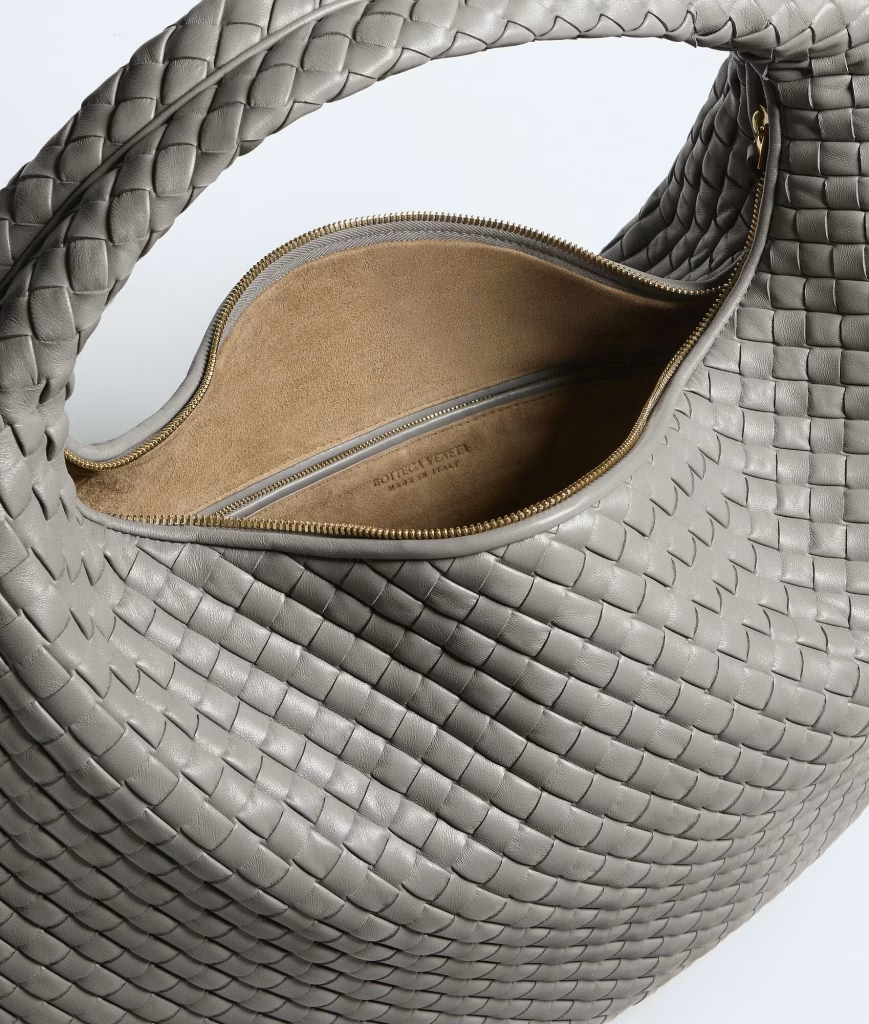
The Maxi Veneta is made from nappa lambskin — the kind of leather that feels almost implausibly soft in the hand. It’s pliable, smooth, and immediately luxurious in an understated way. You don’t need branding when the material itself performs like that.
But softness is doing more than just aesthetic work here – it’s also structural. This bag uses padded intrecciato, meaning the leather strips are not just woven, but cushioned underneath to create that inflated, pillowy effect. That requires more material, more handling, and more precision than a flat panel construction.
So yes, the material choice is intentionally expensive. The $9,100 price-tag is deliberately out of reach.
But here’s the tradeoff that’s not advertised: lambskin is fragile. It scratches easily, creases quickly, and ages in a way that’s far less forgiving than sturdier calfskins. Sometimes, lambskin is even referred to as the “diva of leathers” because it’s notoriously high-maintenance. The Maxi Veneta is not a bag built for longevity — it’s built for experience.
Which is fine. But it does reframe the value.
Verdict: The material absolutely justifies a luxury price – but not out of practical superiority but out of refinement.
#2. The Craft: Labor-Intensive, but Not Limitless
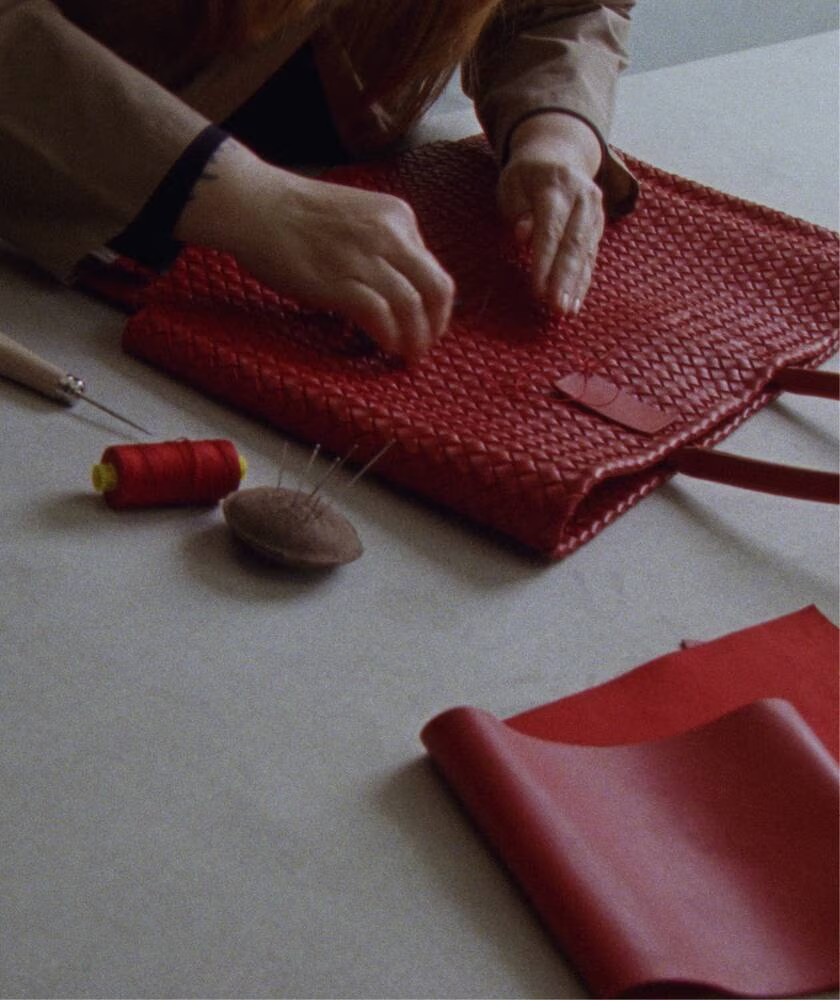
Bottega’s entire identity is tied to the beautiful intrecciato method – the leather weaving technique it’s been refining since the 1970s. Unlike most bags, which are cut into panels and stitched together, this one is constructed from strips of leather that are woven, aligned, padded, and then assembled. I encourage everyone to check out their craft in motion – it’s truly beautiful work.
That’s real labor. It requires control, consistency, and a level of tactile skill that machines still struggle to replicate cleanly – especially with leather this soft.

But it’s important to look past the mythology.
Bottega Veneta isn’t a tiny bespoke workshop producing a handful of bags a week. It’s a global brand operating at massive scale. That weaving process, while still skill-dependent, is also systematized. Techniques are standardized. Training is institutionalized. Output is consistent.
In other words: this is controlled mass-manufactured craftsmanship, not a quirky passion project.
And that matters, because labor – even ultra-skilled labor – doesn’t scale infinitely in cost. At a certain point, you’re no longer paying for how difficult something is to make. You’re paying for how the brand chooses to mythologize that difficulty.
Verdict: Craftsmanship is the strongest justification here. But even that has a ceiling — and this price pushes it to its absolute limit.


#3. The Execution: Where Control Becomes the Product
This is where Bottega quietly separates itself — and where the price starts to feel more grounded.
Most luxury bags distribute complexity across components: hardware, closures, internal structure. Bottega does the opposite. It concentrates everything into the leather itself. No heavy hardware. No rigid frame. No obvious structural shortcuts. Everything is exclusively invested into the leather. That decision shifts the burden of execution upstream.
To produce this bag consistently, the brand needs more than good materials and skilled hands — it needs control: control over hide selection, so the leather is soft enough to weave but stable enough to hold; control over cutting, so each strip behaves predictably across the entire surface; control over tension during weaving, so the pattern stays uniform under stress; and control over finishing, so edges don’t fray and the padding remains even.
And then there’s scale.
It’s one thing to do this well in small quantities. It’s another thing entirely to do it repeatedly, across markets, while maintaining the same look, feel, and tolerance for imperfection. That requires systems: training pipelines, quality checks, production discipline.

This is where Kering (Bottega Veneta’s parent company) actually matters – not just as an abstract corporate parent, but as the infrastructure that allows this level of consistency to exist globally. It cannot be overstated enough just how much productivity and flexibility a global player like Kering can give its brands.
But, even then, there’s a limit.
Because what you’re paying for is not just difficulty – it’s artificial difficulty. A version of craftsmanship that has been refined, curated, and scaled.
And once something is controlled at that level, it stops behaving like pure rarity.
Verdict: Execution is disciplined, specific, and genuinely difficult to maintain — but it still operates within a ceiling that the price exceeds.
#4. The Branding: Where the Price Becomes the Point
This is where things get abstract.
Bottega Veneta operates under Kering, which means it has access to one of the most sophisticated luxury infrastructures in the world: global retail networks, supply chain control, compliance systems, and long-term capital backing.
But what Bottega does with that infrastructure is very specific. It uses it to disappear.
No aggressive logo placement. Minimal reliance on celebrity saturation. At one point, even a near-total withdrawal from social media. On paper, it looks like restraint. In practice, it’s a highly managed form of visibility.
Because if your product doesn’t signal loudly, everything else has to compensate: retail environments become more curated, more controlled; sales staff carry more of the narrative product; consistency becomes non-negotiable; distribution has to be tight enough to preserve exclusivity without limiting growth.


That is not cheaper than traditional luxury marketing. If anything, it’s more delicate – and therefore more expensive to maintain. And crucially: it’s part of what you’re paying for.
Not just the bag, but the system that allows the bag to mean something without saying anything.
Still, we need to be clear about one thing. Infrastructure explains the price. It does not justify it. Because these are business decisions. Strategic ones. Expensive ones. But not inherently valuable to the object itself.
Verdict: You’re paying for a very refined business model — one that turns subtlety into a premium. Whether that’s worth $9,100 is another question entirely.
Final Verdict: Where the Price Becomes Symbolic
The Maxi Veneta is not a scam. That’s too easy, and frankly, too lazy.
It’s a well-made, thoughtfully constructed, materially rich object backed by a brand that understands exactly what it’s doing.
But somewhere between the leather, the weaving, the manufacturing discipline, and the global infrastructure, something shifts.
The price stops reflecting what the bag is and starts reflecting what the brand has decided it means.
Because Bottega doesn’t sell visibility. It sells distinction and craft.
Not status for everyone – status for those who already understand it. And that distinction is powerful. It’s also expensive.
So what are you really paying for?
Material, yes.
Craft, absolutely.
Manufacturing capability, to a point.
Infrastructure, undeniably.
But above all, you’re paying for the ability to carry something that doesn’t announce itself — and still be seen.
And that, more than anything else in this bag, is where the $9,100 starts to make sense…and where it quietly stops.