
If you had told me ten years ago that I’d have anything to say about Proenza Schouler in 2026, I would’ve laughed in your face. It’s a New York brand that has spent the better part of two decades occupying one of fashion’s vaguest positions: technically accomplished, critically respectable, commercially legitimate – and yet completely unidentifiable.
And you don’t have to resort to the American icons, like Ralph Lauren or Donna Karan, to see the point. Proenza’s own contemporary peers have managed to build far more legible identities. Catherine Holstein’s Khaite is more than a decade younger and yet instantly recognizable by its soft-strong leathers, suedes, and grungy New York sensibility. The Olsen sisters’ The Row has championed the language of ‘quiet luxury’, with their cocoon coats and scholarly proportions. And neither has needed logos or monograms to achieve this.
Meanwhile, more than two decades later, ask what Proenza Schouler is, and after seventeen minutes of discussion about “uptown versus downtown,” somebody might eventually mention the the ‘PS1’ backpack. Ouch.
But the Proenza Schouler boys are now gone, having been selected to succeed J.W. Anderson, in leading the Spanish heritage house, Loewe. In their place Rachel Scott – already a New York mainstay herself – was appointed to take the creative lead and debuted last season to lukewarm reception. Her Spring/Summer 2027 collection still fails to entirely solve that problem. But, it may be the first collection in some time to suggest a way out for this ambiguous brand.
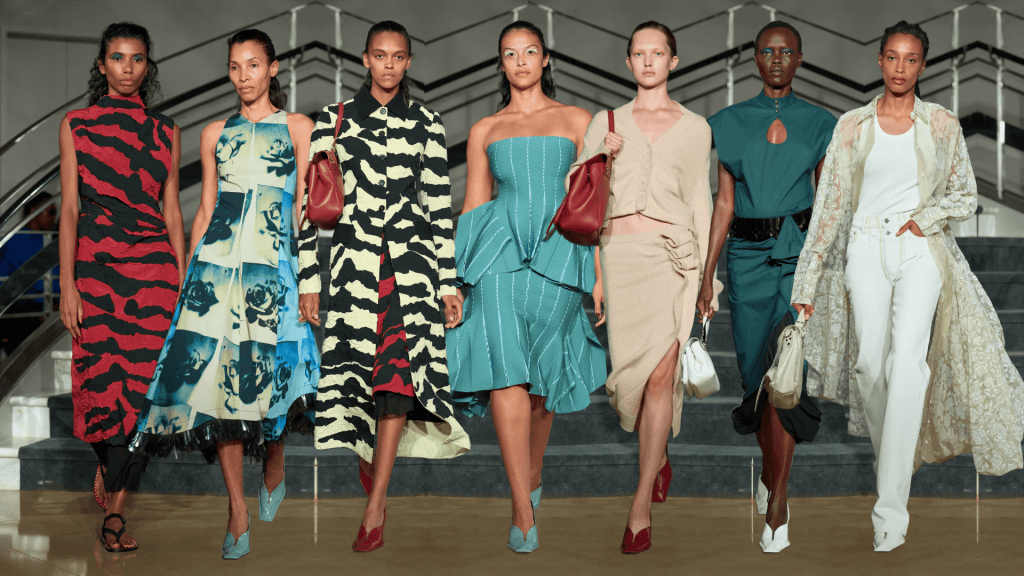
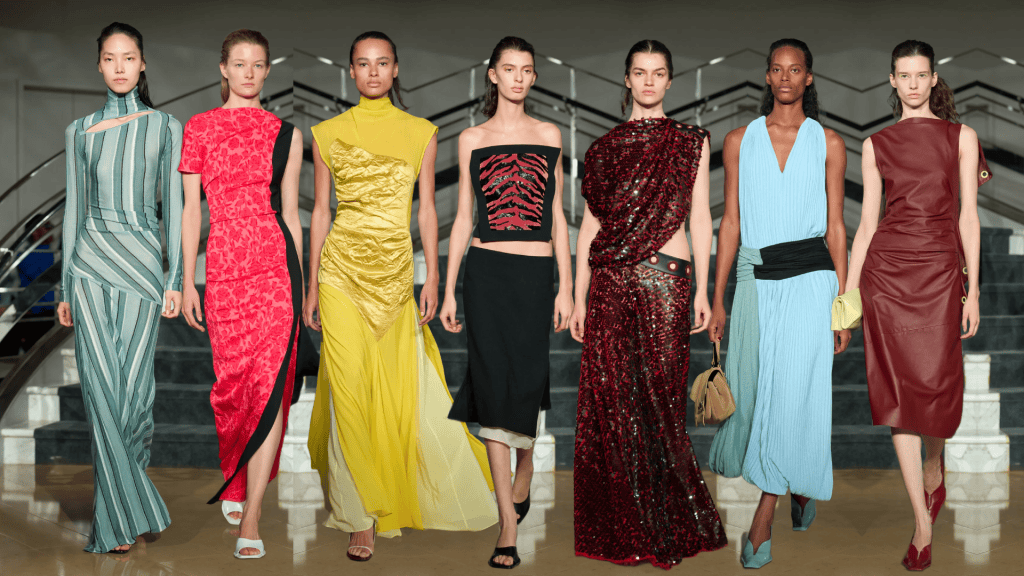
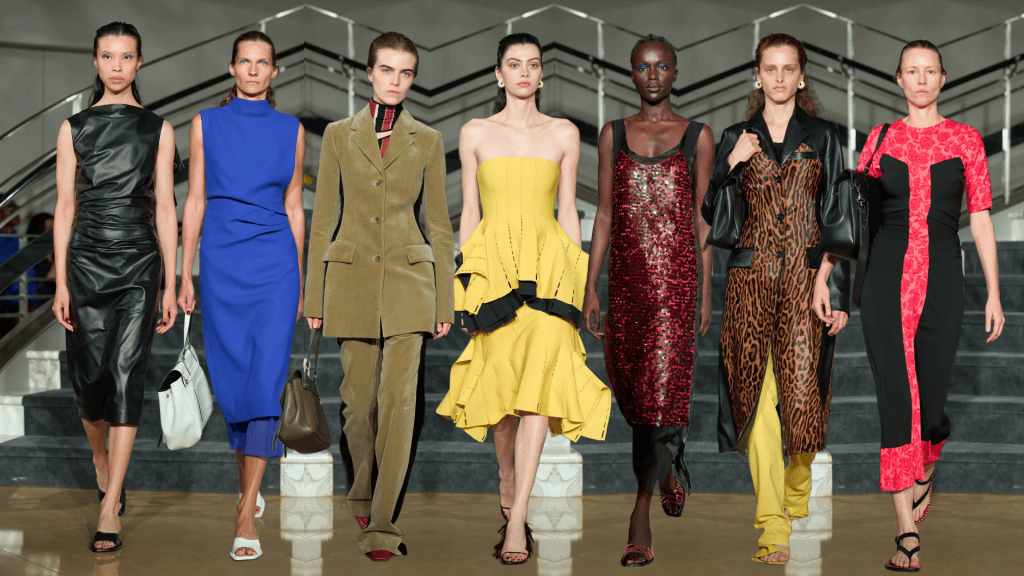
Scott is now looking considerably more comfortable at Proenza than she did at the beginning. The tailoring has relaxed. The body is entering the clothes. Draped dresses buckle, twist and open around the torso; hips round outward; knits move diagonally across the figure rather than obediently tracing it. There are pointelle constructions, vividly colored velvet, sequins designed to audibly scrape against one another in motion, and an animal motif that initially reads like print but is considerably more nuanced.
That striped surface is produced through silk intarsia: two colors of silk constructed together, then placed, bonded and made into the garment. Other iterations appear in plissé, knit and embellished forms. That kind of unnecessarily complicated textile solution is what made the original Proenza Schouler interesting to consumers.
And therein lies the problem.
At their best, Jack McCollough and Lazaro Hernandez made luxury feel slightly off-kilter. They turned leather into faux tweed, suburban ugliness into urban adolescent quirk. That was where their original “uptown/downtown” tension came from: polish against apathy.
By 2026, however, “uptown/downtown” sounds like incredibly tired and dated brand strategy.
This is not retrospective cruelty. British Vogue’s Suzy Menkes was already asking in 2016, while praising the designers’ imagination and craftsmanship, what Proenza Schouler fundamentally stood for. That is quite an indictment after more than a decade in business. The clothes could be excellent while the brand remained weirdly vaporous.
Depending on the season, Proenza has been accused of chasing everyone from Nicolas Ghesquière to Prada to Phoebe Philo, producing a kind of watered-down European fashion in New York. And I think that’s why I’ve always struggled to have any strong opinion on Proenza Schouler. It’s a bit of everything, but nothing in particular at the same time. And that quickly becomes irritating. When a brand lacks any identifiable codes of its own, every resemblance begins to look like evidence.
Which is why Scott is such an interesting choice.
Her greatest contribution to Proenza is not that she understands Proenza Schouler. Frankly, understanding Proenza Schouler may be part of the problem. Scott already possesses a far more distinctive methodology of her own.
At Diotima, she built a vocabulary around material manipulation, Jamaican craft traditions, crochet, starching, movement, texture and the physical behavior of cloth on the body. She has described beginning with material and asking what it is capable of doing. She fits clothes on moving bodies rather than treating the mannequin as gospel. Her experimentation is tactile rather than theatrical: less look at my concept and more what happens if this textile is made to behave differently?
You can see that intelligence creeping into S/S 2027.


Scott has spoken about wanting to introduce “cracks” into the polished Proenza woman, and that’s the best thing here. The most persuasive looks are those in which something controlled begins misbehaving: tailoring slouches, surfaces twist, skin interrupts geometry, embellishment becomes sound. Even the new PS1 Walker follows the same logic. The recognizable skeleton remains, but it is softened, curved and made less rigid.
The collection becomes less convincing whenever Scott gets too respectful. I think she often handles the brand with archival white gloves, perhaps over-concerned with dutifully proving that she understands its vocabulary before allowing herself to vandalize it. But with a faceless brand like Proenza Schouler, this is perhaps her best opportunity to take creative license.


Because ultimately, admiration is not the answer. S/S 2027 is sophisticated. It is beautifully worked. It is frequently elegant. But luxury fashion is currently drowning in brands capable of producing sophisticated, beautifully worked, elegant clothes. That’s not in shortage in 2026.
Proenza Schouler does not need Rachel Scott to make it tasteful. It needs her to make it strange. Off-beat. New.
Not only is this necessary for the brand, but for New York fashion in general. NYFW hardly suffers from a shortage of tasteful clothes. What it has lacked is enough major American fashion with the confidence, resources and appetite to propose something genuinely specific. Scott has the experimental instincts to do that, and Proenza has the infrastructure to let her push them much further than she has so far.
Perhaps the solution to Proenza Schouler’s twenty-year identity crisis is not for Rachel Scott to become more Proenza Schouler. But for Proenza Schouler needs to become more Rachel Scott.
New York has enough good taste. What it needs is nerve.


